Dental crowns and partial crowns
Even a badly damaged tooth can usually be saved. A crown or partial crown restores its shape, stability and chewing function. That way you keep your own tooth.
Why a crown preserves your own tooth
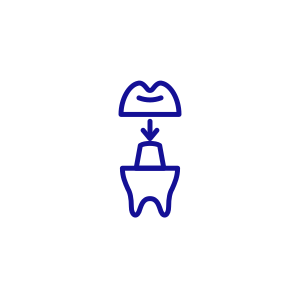
Chewing puts strong forces on every tooth, and a healthy tooth copes with them easily. Once decay has destroyed too much tooth structure, or the walls have become too thin, there is an increased risk that the tooth will break under load. This is where a crown can help: it encases the tooth and spreads the chewing forces evenly again. For root-treated back teeth, too, a crown is often advisable.
Even so, a crown is not the first choice as long as a smaller solution will hold. After all, the tooth has to be prepared for it and loses structure that does not come back. That is why we always look for the solution that preserves as much of your own tooth as possible. Depending on the defect, a partial crown, an inlay or an onlay may be enough on its own. In that case only the destroyed part of the tooth is replaced and the healthy part is preserved. After five years, around 95 out of 100 ceramic crowns are still functioning, and after ten years about 80 to 90 of them. Good care and regular check-ups improve these prospects.
How we proceed
- 01 Examination, advice and planning
First we establish how badly the tooth is damaged and which restoration is right for it. An X-ray lets us assess the depth of the defect and the condition of the tooth root and the periodontium, the tissues that hold the tooth in place. If the tooth nerve is affected, we first check whether it can be preserved. In such cases a root canal treatment is often needed.
- 02 Preparing the tooth and digital scan
Under local anaesthetic we remove the damaged structure and, if necessary, rebuild the tooth. If a root-treated tooth is badly broken down, we anchor the crown with a glass fibre post in the tooth root. We then prepare the tooth so that the crown has sufficient thickness. We place the crown margin only as far below the gum as necessary. After that we take a digital impression. It is just as precise as a conventional impression and considerably more comfortable for most patients. You can read more on our page about the intraoral scanner.
- 03 Temporary crown and fabrication in the laboratory
While your crown is being made, a temporary acrylic crown protects the prepared tooth. You can speak and eat with it. During this time, though, you should avoid very hard and sticky foods, because it is not as robust as the finished crown. Your crown is made by one of our specialist dental laboratories. The dental technician matches its colour and shape to your own teeth.
- 04 Fitting the crown
At a further appointment we place the crown and check the fit and the bite (occlusion). Thanks to digital fabrication it usually fits precisely first time. If your bite still feels unfamiliar once the anaesthetic has worn off, we adjust the crown at a follow-up appointment. Good oral hygiene and regular preventive care are important if the crown is to last.
Good to know
You have a choice of materials. As a rule we use metal-free crowns. Zirconia crowns (zirconium oxide) are particularly strong and are therefore often chosen for the back teeth, where the greatest forces act during chewing. For the front teeth, glass ceramic (lithium disilicate) looks even more natural. It is, however, somewhat less resilient. The most natural appearance comes from a layered all-ceramic crown. Its framework is coated by hand in the laboratory, layer by layer, with a fine veneering ceramic (feldspathic ceramic). This layer is more delicate and needs more maintenance, as it can chip over the years. In return, the result is usually indistinguishable from a natural tooth. For price-conscious patients, ceramic composite can be a solution. It wears down more quickly and can discolour. In return it is cheaper and easy to repair. On current evidence, however, it does not last as long as ceramic on average. We will discuss with you which material suits your situation best.
The crown itself cannot decay. The tooth underneath can. The most vulnerable spot is the junction between crown and tooth: this is where new decay is most likely to start. How often that happens depends heavily on how well you look after your teeth. In a study of more than 1,000 crowns and bridges, decay at the margin occurred around four times as often with poor oral hygiene as with good care. So clean between your teeth every day as well, and come regularly for professional dental cleaning and preventive care.
In all honesty: preparing the tooth can leave it sensitive for a while. In about 5 out of 100 crowned teeth, the tooth nerve dies in the years after treatment, and more often in teeth that were already badly damaged. A root canal treatment then becomes necessary. Ceramic is hard-wearing. It can still break. If you grind your teeth at night, we recommend an occlusal splint to take the load off the crown and your own teeth. You can read more on our page about teeth grinding and the jaw joint. Occasionally a crown can also work loose. That can be a sign of a defect that is progressing. If a defect can be ruled out, we simply cement it back in place. Not every tooth can be saved with a crown. If too much structure is missing, or the tooth cannot be preserved even with a root canal treatment, we will discuss replacing it with an implant.
Treatments in this area
- All-ceramic crown
Encases a badly damaged tooth and protects it. Made of strong zirconia or of especially natural-looking glass ceramic.
- Layered all-ceramic crown
For a particularly natural result in the visible zone. The framework is coated with ceramic by hand in the laboratory.
- Partial crown
Replaces only the destroyed part of the tooth. This preserves considerably more healthy tooth structure than a full crown.
- Post and core build-up
Anchors the crown when little of the tooth is left: a post in the root gives the build-up a firm hold.
- Replacing an old crown
Replaces a crown that has started to leak, has worked loose or no longer looks good. We check the tooth underneath and give it a fresh restoration.
- Crown on an implant
Replaces a missing tooth including its root. You can read more in the dental implants and full-mouth rehabilitation section.
Your first appointment
At your first appointment we examine your tooth, and you find out whether it needs a crown. You will receive a clear assessment of the material, the work involved and the alternatives. And time to decide at your own pace.
More treatments
-
Digital dentistry
Examine thoroughly, plan precisely, deliver digitally: from the first diagnosis to the finished restoration, we work digitally throughout. This makes treatments more accurate, more comfortable and more predictable.
-
Professional dental cleaning and preventive care
Healthy teeth begin with good prevention. Professional dental cleanings as part of a personalised preventive care plan remove plaque, tartar and discolouration before problems arise.
-
Periodontics and gum health
Bleeding gums are a warning sign. We treat gingivitis and periodontitis with modern periodontal therapies to preserve your teeth and jawbone.
-
Conservative dentistry: fillings, inlays and onlays
Your own tooth is the best tooth there is. We take the least invasive approach to tooth decay and minor damage, using fillings in the natural colour of your tooth, and restore larger defects with precisely fitted ceramic inlays and onlays. This way, as much healthy tooth structure as possible is preserved.
-
Root canal treatment (endodontics)
An inflamed tooth nerve does not mean the end of the tooth. Wherever possible, we keep the living nerve. Where that is not possible, a root canal treatment removes the inflammation from inside the tooth, relieves the pain and saves the tooth from extraction.
-
Orthodontics and invisible aligners
We correct tooth position and bite with treatments tailored to each patient: from traditional braces to invisible aligners, for children, teenagers and adults.
-
Dental crowns and partial crowns
Even a badly damaged tooth can usually be saved. A crown or partial crown restores its shape, stability and chewing function. That way you keep your own tooth.
-
Tooth extraction and wisdom teeth
Sometimes a tooth extraction is the right treatment: when a tooth can no longer be saved or is completely in the wrong position, or when a wisdom tooth is causing problems. In that case we remove the tooth gently under local anaesthetic and, where needed, plan the right tooth replacement before the procedure. That way no permanent gap remains after the extraction.
-
Dental implants and tooth replacement
The right answer for every gap: we replace a single missing tooth with an implant and a crown. If several teeth are missing, we close the gap with individual implants or an implant-supported bridge. And even for a jaw with no teeth left, we have fixed solutions that look good.
-
Cosmetic dentistry
Healthy teeth can be beautiful too: we whiten them in a controlled way and correct shape and colour with veneers or tooth-coloured composite. You decide what should change, and we work as conservatively as possible.
-
Children's dentistry
From the very first milk tooth: we support your child’s dental development with relaxed check-ups, fissure sealants and, where needed, gentle treatment of tooth decay.
-
Teeth grinding and TMJ disorders
Teeth grinding, jaw pain and clicking in the jaw joint rarely have a single cause. We examine the function of the joint and the muscles and check the teeth for signs of grinding and clenching. A custom-fitted occlusal splint is often used, combined where needed with physiotherapy and other specialities.
-
Snoring and sleep apnoea treatment
In many cases, snoring and obstructive sleep apnoea can be treated at the dental practice: with a custom-fitted splint that you wear at night.
-
Nervous patients
Time, clear arrangements and an agreed stop signal: gentle dentistry for everyone who finds visiting the dentist difficult.