Root canal treatment (endodontics)
An inflamed tooth nerve does not mean the end of the tooth. Wherever possible, we keep the living nerve. Where that is not possible, a root canal treatment removes the inflammation from inside the tooth, relieves the pain and saves the tooth from extraction.
Why we save your tooth instead of taking it out
When decay reaches deep inside the tooth, or a tooth is damaged in an accident, the pulp can become inflamed. This is the tooth nerve with its fine blood vessels. Inflammation of this kind often causes severe pain. In the past, the affected tooth was frequently lost as a result. Today that is no longer the case. Modern endodontics preserves teeth that would otherwise have to be taken out. It is worth the effort, because no tooth replacement is as good as your own tooth with its natural anchoring in the jaw. The chances of success are well documented. About nine out of ten root-treated teeth are still in place after ten years.
We take this step by step. Not every inflamed nerve is beyond saving. If the inflammation is still reversible, the living nerve can be preserved in suitable cases. Only when it is irreversibly damaged or has already died do we remove it with a root canal treatment. And even after that there are ways to save a tooth, from redoing an old root canal to an apicoectomy (surgery at the root tip). There are no guarantees in medicine, but before every treatment we tell you what the outlook is for your tooth.
How we proceed
- 01 Examination and diagnosis
We begin by finding out what is causing the pain and how the tooth nerve is doing. To do this we test the vitality of the tooth and take a targeted X-ray. This shows us whether the nerve can still be saved or whether a root canal treatment is needed. We discuss the findings and the chances of success openly with you before we start.
- 02 Where possible: keeping the living nerve
If the inflammation is still reversible, we cover the nerve with a tissue-friendly bioceramic material and keep it alive. Where that is not enough, we remove only the inflamed part inside the crown of the tooth and leave the healthy part in the root alive. This procedure is called a pulpotomy. Studies show success rates of around 90 per cent over several years for keeping the nerve alive in suitable cases. This path often begins with the gentle removal of decay, and you can read more about it on the conservative dentistry page.
- 03 The root canal treatment
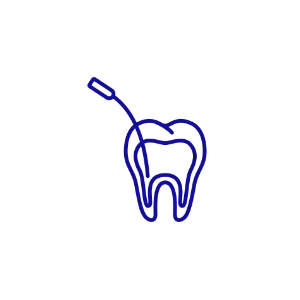
If the nerve has to be removed, we work under local anaesthetic and isolate the tooth with a rubber dam (a stretched sheet of rubber that keeps saliva and bacteria away). Through a small opening in the crown of the tooth, we clean the fine root canals with computer-controlled, flexible files and flush them several times with disinfectant solutions. Magnifying loupes help us spot even hidden canal entrances. We then fill the canals tightly with gutta-percha, a rubber-like natural material, and a bioceramic sealer, so that no bacteria can get back into the tooth and the inflammation can subside. One session is often enough, though sometimes two are needed.
- 04 Rebuilding and protecting the tooth
After the root treatment we rebuild the tooth. Where a lot of tooth structure has been lost, a post in the root anchors the build-up. We protect badly weakened teeth with a crown, because root-treated teeth with large fillings can break more easily. Studies show that they last considerably longer with a crown, and you can read more about it on the dental crowns page.
Good to know
Few procedures cause patients as much apprehension as a root canal treatment. Its reputation is worse than the reality. The severe pain comes from the inflamed nerve, not from the treatment. Under effective local anaesthetic it is no more unpleasant for most patients than a larger filling. After the appointment the tooth can be sensitive for a few days, and this usually settles on its own.
Honesty also means saying that every root canal treatment has its limits. Root canals are often sharply curved, branched or calcified over the years, and in rare cases the fine instruments can break inside the canal. With complicated canal shapes, a three-dimensional CBCT scan helps us understand the tooth precisely before treatment. Even with the greatest care, not every inflammation heals completely.
That is exactly when there is a second and even a third chance. In a retreatment we remove the old root filling, clean the canals again and seal them tightly. The chances of success are good, but lower than those of the first treatment. We discuss with you beforehand what is realistic in your case. If even that is not enough, an apicoectomy removes the inflammation directly at the tip of the root. This is a small surgical procedure and often the last step before a tooth would have to be taken out.
Rarely, a chronically inflamed nerve dissolves the dentine from the inside. This is called internal resorption. It usually causes no symptoms and shows up as an incidental finding on an X-ray. If it is caught early, a root canal treatment stops the process. This is another reason why regular check-ups are valuable.
Treatments in this area
- Keeping the tooth nerve alive
Preserves the living nerve with a targeted covering of bioceramic material before a root canal treatment becomes necessary.
- Root canal treatment
Removes the infection from inside the tooth and saves it instead of extracting it.
- Endodontic retreatment
A second chance for teeth with an old root canal that has failed.
- Apicoectomy (root-end surgery)
When a root canal is not enough: microsurgery removes the infection at the root tip and preserves the tooth.
Your first appointment
At your first appointment we examine the tooth and discuss openly whether and how it can be saved. If you are in acute pain, we relieve it as quickly as possible.
More treatments
-
Digital dentistry
Examine thoroughly, plan precisely, deliver digitally: from the first diagnosis to the finished restoration, we work digitally throughout. This makes treatments more accurate, more comfortable and more predictable.
-
Professional dental cleaning and preventive care
Healthy teeth begin with good prevention. Professional dental cleanings as part of a personalised preventive care plan remove plaque, tartar and discolouration before problems arise.
-
Periodontics and gum health
Bleeding gums are a warning sign. We treat gingivitis and periodontitis with modern periodontal therapies to preserve your teeth and jawbone.
-
Conservative dentistry: fillings, inlays and onlays
Your own tooth is the best tooth there is. We take the least invasive approach to tooth decay and minor damage, using fillings in the natural colour of your tooth, and restore larger defects with precisely fitted ceramic inlays and onlays. This way, as much healthy tooth structure as possible is preserved.
-
Root canal treatment (endodontics)
An inflamed tooth nerve does not mean the end of the tooth. Wherever possible, we keep the living nerve. Where that is not possible, a root canal treatment removes the inflammation from inside the tooth, relieves the pain and saves the tooth from extraction.
-
Orthodontics and invisible aligners
We correct tooth position and bite with treatments tailored to each patient: from traditional braces to invisible aligners, for children, teenagers and adults.
-
Dental crowns and partial crowns
Even a badly damaged tooth can usually be saved. A crown or partial crown restores its shape, stability and chewing function. That way you keep your own tooth.
-
Tooth extraction and wisdom teeth
Sometimes a tooth extraction is the right treatment: when a tooth can no longer be saved or is completely in the wrong position, or when a wisdom tooth is causing problems. In that case we remove the tooth gently under local anaesthetic and, where needed, plan the right tooth replacement before the procedure. That way no permanent gap remains after the extraction.
-
Dental implants and tooth replacement
The right answer for every gap: we replace a single missing tooth with an implant and a crown. If several teeth are missing, we close the gap with individual implants or an implant-supported bridge. And even for a jaw with no teeth left, we have fixed solutions that look good.
-
Cosmetic dentistry
Healthy teeth can be beautiful too: we whiten them in a controlled way and correct shape and colour with veneers or tooth-coloured composite. You decide what should change, and we work as conservatively as possible.
-
Children's dentistry
From the very first milk tooth: we support your child’s dental development with relaxed check-ups, fissure sealants and, where needed, gentle treatment of tooth decay.
-
Teeth grinding and TMJ disorders
Teeth grinding, jaw pain and clicking in the jaw joint rarely have a single cause. We examine the function of the joint and the muscles and check the teeth for signs of grinding and clenching. A custom-fitted occlusal splint is often used, combined where needed with physiotherapy and other specialities.
-
Snoring and sleep apnoea treatment
In many cases, snoring and obstructive sleep apnoea can be treated at the dental practice: with a custom-fitted splint that you wear at night.
-
Nervous patients
Time, clear arrangements and an agreed stop signal: gentle dentistry for everyone who finds visiting the dentist difficult.